
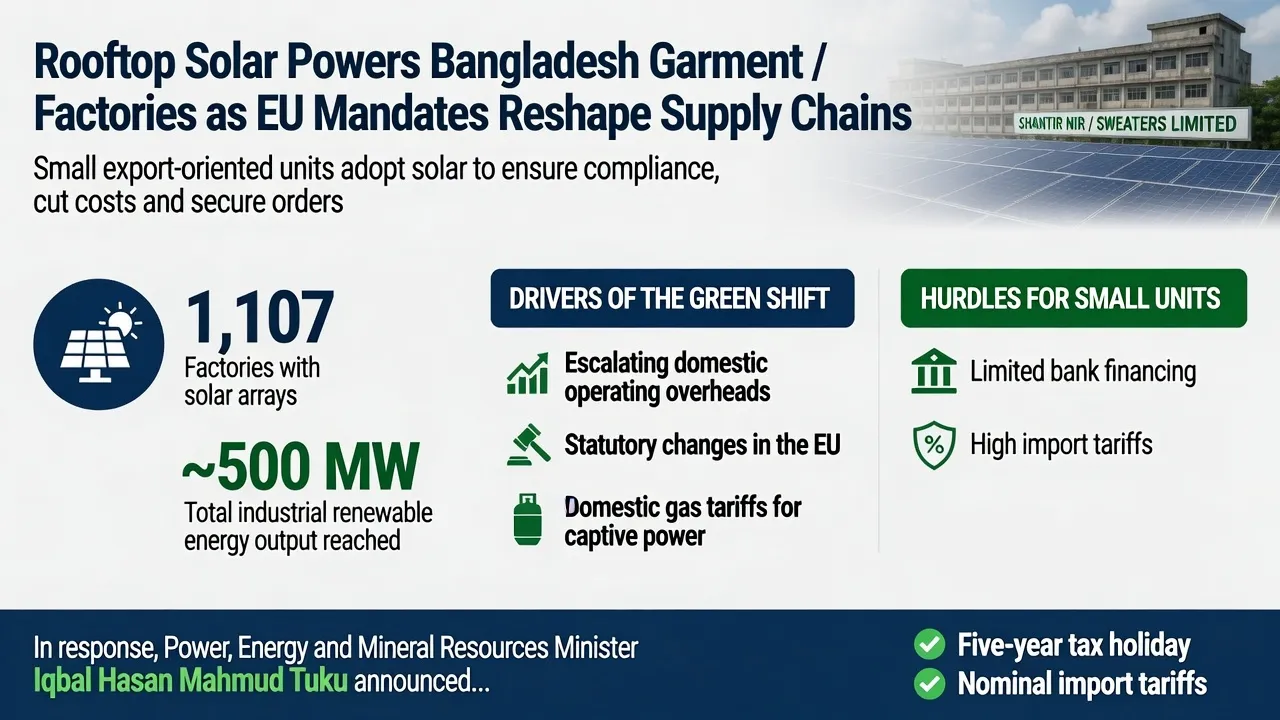
Small export-oriented garment factories across Bangladesh are increasingly installing rooftop solar systems to satisfy stringent European trade mandates. This rapid transition ensures long-term business survival as Western brands threaten to redirect purchasing orders from non-compliant facilities.
A recent survey by research platform Mapped revealed that 1,107 out of 3,320 garment operations have adopted solar arrays, including 506 small and medium enterprises employing fewer than 1,000 individuals. Total industrial renewable energy output has reached nearly 500 megawatts, with an additional 500 megawatts projected to come online by next year. For instance, Shantir Nir Sweaters Limited lowered its monthly electricity expenditure from Tk 3.5 lakh to Tk 1.21 lakh after a self-funded Tk 1 crore transition. Similarly, Fatullah Apparels now offsets 25 per cent of its energy demand via a Tk 56 lakh solar installation.
The green shift is accelerated by escalating domestic operating overheads alongside statutory changes in the European Union (EU), which receives roughly 44% of Bangladeshi apparel exports. The upcoming Corporate Sustainability Due Diligence Directive (CSDDD) and mandatory Digital Product Passports (DPPs) require verified supply-chain decarbonization by 2030. Concurrently, domestic gas tariffs for captive power generation spiked by 286% over five years, compounded by a recent 16% fuel price hike. Global retail giants like H&M and Lindex HK Limited have cautioned that suppliers failing to implement green transitions will face volume reductions or complete commercial termination.
Despite clear commercial incentives, small manufacturing units face steep hurdles due to limited bank financing and high import tariffs. Salehuddin Zaman Khan, former vice-president of the Bangladesh Textile Mills Association (BTMA), noted that import duties on certain solar components reach up to 77%, inflating local project costs by nearly 50% compared to regional competitors like India. Furthermore, commercial lenders hesitate to extend sustainable credit lines to smaller ventures due to collateral challenges and prolonged payback periods. In response, Power, Energy and Mineral Resources Minister Iqbal Hasan Mahmud Tuku announced that the government is drafting an investment-friendly policy to introduce a five-year tax holiday and nominal import tariffs by June.

Discussion
No published comments yet. Be the first to join the discussion.