
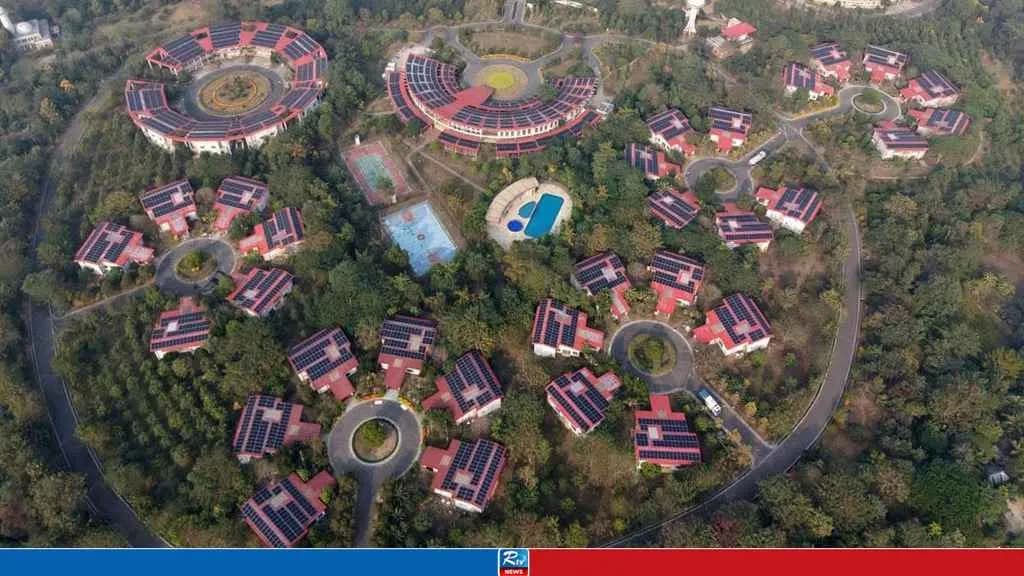
The use of eco-friendly ‘green energy’ or renewable energy in the maintenance and operation of the Padma Bridge, one of the country’s mega-infrastructures, has reached a new milestone. A state-of-the-art solar power system with a capacity of 2.49 megawatt-peak (MWp) has been successfully installed and commissioned at Service Area-2 of the Padma Bridge, which falls under the Bangladesh Bridge Authority. This initiative is saving a massive amount of electricity in the bridge area, significantly contributing to the government’s efforts to ensure national energy security.
The Prime Minister consistently encourages the nation to increase the use of renewable energy and solar systems. The Ministry of Road Transport and Bridges is working relentlessly to turn her ‘green energy’ vision into reality.
In a statement regarding the success of utilizing solar power in the Padma Bridge area, Bridges Division Secretary and Bangladesh Bridge Authority Executive Director Mohammed Abdur Rouf said, “The successful application of renewable energy in a national infrastructure like the Padma Bridge is highly significant. It is not only reducing electricity bill costs but also playing a major role in protecting the environment and cutting carbon emissions. The Bridge Authority will always play a pioneering role in implementing the government’s visionary policies.”
The electricity generated by the solar system installed in Service Area-2 has been connected to the national grid using a ‘net metering’ system. During daylight, the electricity produced by the solar panels meets the service area’s own demand. The surplus electricity is then directly fed into the national grid. At night or on cloudy days, the electricity drawn from the grid is adjusted against the power supplied during the day. As a result, the service area’s overall electricity bill has dropped massively, saving substantial government funds. In addition to preserving the environmental balance, this has proven to be a highly effective model.
Highlighting the statistics on savings, the authority stated that due to the use of solar power in Service Area-2, no bill was issued for electricity consumption in June (2026); the only bill received was BDT 75,714 for demand charges. In contrast, the electricity bill for the preceding month of May was BDT 521,064. In May, a total of 54,000 kilowatt-hours (units) of electricity was supplied to the national grid from the solar system. Meanwhile, 34,000 units were consumed from the Shariatpur Palli Bidyut Samity. Consequently, the Bangladesh Bridge Authority still holds a surplus of 20,000 units of electricity.
Currently, the combined solar power generation capacity at Service Area-1, Service Area-2, and Service Area-3 of the Padma Bridge stands at 6.03 megawatts. Net metering operations are already actively underway in Service Area-1 and 3.


Discussion
No published comments yet. Be the first to join the discussion.