
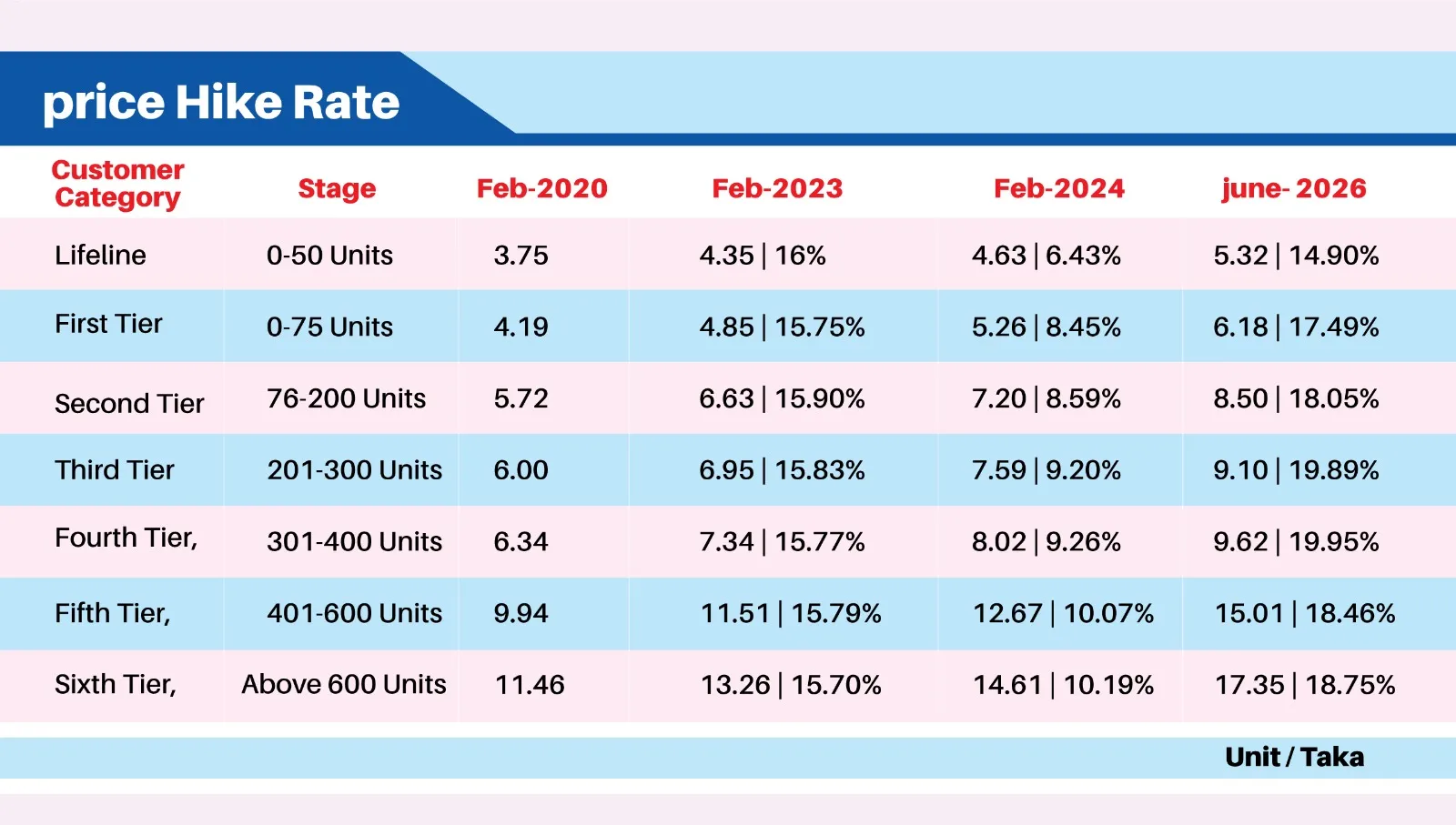
The Bangladesh Energy Regulatory Commission (BERC) has once again significantly increased electricity prices in the country. Under the new announcement, electricity prices have been raised by an average of 16.68 percent at the consumer level and 19.85 percent at the wholesale level. At the same time, transmission charges have also been increased by approximately 24 percent.
BERC Chairman Jalal Ahmed announced the new tariffs at a press conference held in the capital on Wednesday. According to the commission’s decision, the new rates will be effective from June, and consumers will have to pay the increased bills in July.
According to the new tariff structure, the average price of electricity at the wholesale level has risen from Tk 7.04 to Tk 8.39 per unit. On the other hand, the transmission cost has been raised from 31 paisa to approximately 39 paisa per unit.
Additional Pressure on Residential Consumers
Under the new rates, electricity prices have increased significantly across almost all tiers for residential consumers. For lifeline consumers, the price per unit has been raised from Tk 4.63 to Tk 5.32. The price of electricity per unit has been set at Tk 6.18 for users of up to 75 units, Tk 8.50 for users of 76 to 200 units, and Tk 9.10 for users of 201 to 300 units.
In addition, usage between 301 and 400 units will cost Tk 9.62 per unit, 401 to 600 units will cost Tk 15.01, and usage exceeding 600 units will incur a charge of Tk 17.35 per unit. According to experts, this price hike will significantly increase the monthly expenses of middle-class and lower-middle-class families.
Impact on the Industrial and Commercial Sectors
The electricity price hike will also increase production costs in the industrial and commercial sectors. Electricity prices have been raised for low-pressure, medium-pressure, and high-pressure industrial consumers during both peak and off-peak hours. For small and cottage industries, the price of electricity per unit has been fixed at Tk 15.27 during peak hours and Tk 11.45 during off-peak hours.
Electricity prices for commercial and office consumers have also increased by 18 to 20 percent. Analysts fear that due to rising production costs, the prices of industrial goods may also increase, the impact of which will ultimately fall on consumers.
Additional Costs for Irrigation, Hospitals, and Battery Charging
According to the new decision, electricity prices have also been increased for agricultural irrigation, hospitals, educational institutions, religious institutions, and electric vehicle battery charging. For agricultural irrigation, the price of electricity per unit has increased from Tk 5.25 to Tk 6.04. On the other hand, prices have also been significantly adjusted across various categories for electric vehicles and battery charging.
Why Was the Price Increased?
Relevant agencies in the power sector claim that the electricity prices need to be adjusted due to the rising costs of production, importation, and maintenance. According to the Bangladesh Power Development Board (BPDB), the cost of electricity production in the upcoming fiscal year may stand at around Tk 1,43,000 crore.
BERC Chairman Jalal Ahmed stated that this decision was taken considering the current economic reality and the pressure of subsidies in the power sector. According to him, even after the price hike, the government will still have to provide a subsidy of around Tk 41,000 crore.
Criticism from Consumers
However, consumer rights organizations, business representatives, and people from various professions have strongly criticized this hike in electricity prices. They allege that increasing electricity prices amidst soaring commodity prices will further escalate the cost of living for ordinary people.
Leaders of the consumer rights organization CAB claimed that the burden is being directly imposed on consumers without taking initiatives to reduce corruption, inefficiency, and unnecessary expenditures in the power sector. According to them, this record hike in electricity prices will create new pressure on industrial production, trade and commerce, and the living expenses of ordinary people.
Discussion
No published comments yet. Be the first to join the discussion.