
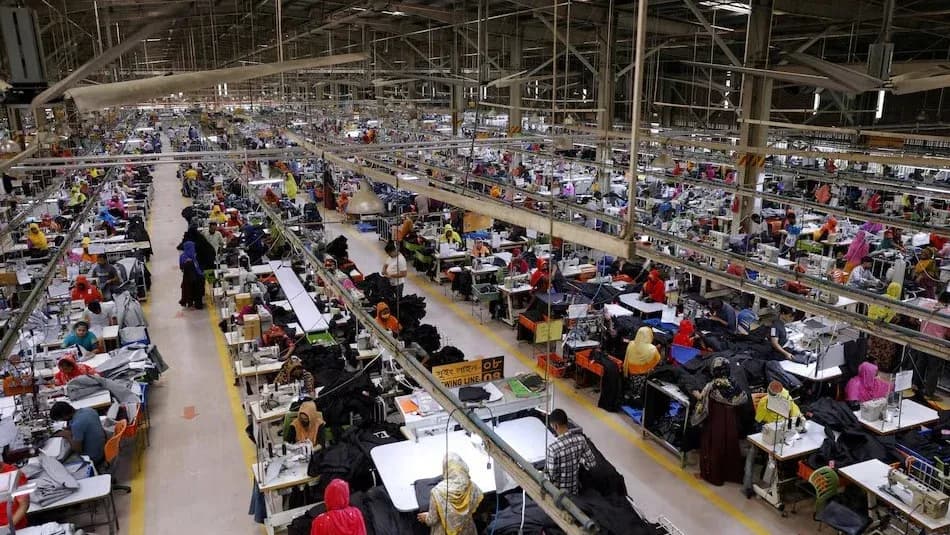
At least Tk 35,000 crore in private investments across various economic and industrial zones in the country is virtually stalled due to a gas connection crisis. With numerous factories that are ready for production lying idle for years, employment generation has come to a halt, the debt burden on entrepreneurs is mounting, and the financing of the banking sector is at risk.
Despite making substantial investments in various industries, including steel, readymade garments, cement, and seed crushing, most factories cannot commence operations as they are unable to secure gas connections. Investigations reveal that the actual investment volume associated with the pending gas connection applications could be much higher. According to sources within the Energy Division, approximately 1,800 gas connection applications are still pending.
City Group has constructed six large industrial units with an investment of about Tk 11,000 crore in the Hosendi Economic Zone in Munshiganj. Although the zone was established nearly six years ago, the factories have yet to go into production due to the lack of a gas connection.
Mohammad Hasan, Managing Director of City Group, stated that despite the massive investment, no revenue has been generated. Yet, they are required to pay bank loan interest and installments regularly. He added that production at their existing factories has also declined due to low gas pressure.
He further mentioned that Tk 150 crore was deposited as a security guarantee with the Titas Gas authorities in 2018 and 2021 for the Hosendi Economic Zone. Nevertheless, the connection has not been provided.
Officials from various banks reported that the cash flow from City Group’s ongoing businesses is now being diverted to repay the loans for the new economic zone. As a result, pressure has mounted on their working capital as well.
Meanwhile, massive investments remain stuck in two economic zones belonging to Meghna Group. The conglomerate has invested approximately Tk 6,000 crore in the Meghna Economic Zone in Narayanganj and around Tk 10,000 crore in the Cumilla Economic Zone.
Meghna Group Chairman Mostafa Kamal said that despite knocking on the doors of various departments for a gas connection since 2022, no solution has been found. He noted that about $400 million has been invested in a steel plant and another $300 million in glass and paper board factories. Merely maintaining these facilities costs about Tk 80 crore annually.
He further stated that although Tk 100 crore was provided for grid development and another Tk 100 crore for pipeline infrastructure development to expedite the gas supply, the connection remains elusive.
Abdul Monem Group also developed an economic zone with an investment of about Tk 5,000 crore but failed to launch most of its industrial units due to the gas crisis. Only one motor vehicle assembly plant has managed to go into production there.
Officials of the group reported that the interest of domestic and foreign investors has dwindled due to the lack of gas connections. To cope with the financial strain, the group has even had to resort to selling off some assets.
In the Kishoreganj Economic Zone, Nitol Niloy Group and India’s Tata Group have also been unable to commence production despite making significant investments. The situation is identical for the projects of Aman Group, Bay Group, Bashundhara Group, and TK Group.
Bashundhara Group has invested approximately Tk 1,023 crore in a seed crushing plant in Narayanganj. However, despite repeated applications since 2022, it has not received a gas connection. Similarly, TK Group is awaiting a gas connection after completing the construction of a steel mill in Chattogram.
Business leaders say that at the time of investment in the economic zones, the government promised uninterrupted gas and electricity supplies. But in reality, that promise has not been kept.
The situation in government economic zones is not much different. Although infrastructure construction has been completed in several zones, including the Mirsharai Economic Zone, Jamalpur Economic Zone, and Sirajganj Economic Zone, investment activities have slowed down due to the gas crisis.
According to Ministry of Energy sources, gas connection applications from nearly 1,800 industrial establishments remained pending as of April. Among them, about 550 establishments have been waiting for connections for four to five years, despite having deposited the demand note fees.
Finance Minister Amir Khosru Mahmud Chowdhury recently stated at a roundtable meeting that feasibility studies were not conducted properly at the inception of establishing the economic zones. He noted that the government’s current priority is to facilitate the ease of doing business and take effective initiatives to resolve utility issues like gas and electricity.
On the other hand, Energy Minister Iqbal Hasan Mahmud said that rules and regulations regarding industrial gas connections were not followed during the previous government’s tenure. It will now take time to bring discipline back to the energy sector.
According to Petrobangla data, the country’s current daily gas demand is about 3.8 billion cubic feet. However, only 2.6 to 2.7 billion cubic feet can be supplied. Consequently, industrial plants, power stations, and even fertilizer factories are not getting gas according to their demand.
Experts say that Bangladesh’s industrialization has primarily been built on gas as an affordable and reliable fuel. Although diesel can be used as an alternative to gas for heat and power generation in industries, it increases production costs by two to three times, which weakens competitiveness in the international market.
Abul Kalam Azad, a consultant in the spinning sector, stated that even though gas prices have increased, captive power generation remains comparatively cost-effective. Therefore, no viable alternative to an uninterrupted gas supply for the industrial sector has yet been created.
Discussion
No published comments yet. Be the first to join the discussion.