
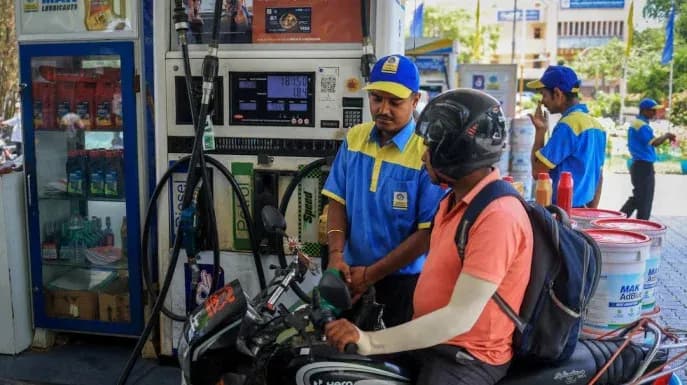
The ongoing tensions in the Middle East surrounding Iran have now directly impacted India’s fuel market. Due to an abnormal surge in crude oil prices in the international market, the country’s state-owned oil marketing companies have once again increased the prices of petrol and diesel.
This marks the third price hike within the last eight days. On Saturday, the price of petrol was increased by 87 paise per liter and diesel by 91 paise per liter in the capital, Delhi. New prices have also been implemented proportionally in other states.
Following this latest hike, petrol prices have risen by a total of Rs 4.77 and diesel by Rs 4.81 in Delhi since May 15. On May 15, Indian oil companies decided to raise fuel prices for the first time in over four years. Under the new pricing, petrol is being sold at Rs 99.51 per liter and diesel at Rs 92.49 per liter in Delhi.
However, prices vary across different regions due to differences in state taxes. Prior to this, prices were increased by 90 paise per liter last Tuesday and by Rs 3 in a single hike on May 15. India’s Ministry of Petroleum stated that the daily losses of state-owned oil marketing companies have somewhat decreased following the May 15 price hike.
Nevertheless, relevant authorities reported that a daily loss of approximately Rs 750 crore is still being incurred on the sale of petrol, diesel, and LPG.
Global Market Under Pressure from War and Hormuz Crisis
Crude oil prices in the international market have surged by more than 50 percent due to the ongoing conflict in West Asia and fears of disrupted shipping in the Strait of Hormuz. Under these circumstances, India’s state-owned oil companies had attempted to protect consumers by refraining from raising retail prices for an extended period. Petrol and diesel prices had not been increased in the past four years. Instead, prices were reduced ahead of the 2024 Lok Sabha elections.
However, due to the deteriorating situation, the government and state-owned oil companies decided to increase prices in phases.
Political and Economic Calculations
According to analysts, the government did not want to increase fuel prices for political reasons during the assembly elections in several states. The price adjustment process began immediately after the elections concluded. Although the government does not directly determine retail prices in India’s fuel market, state-owned oil marketing companies—which control nearly 90 percent of the market—set prices in coordination with the government. Industry sources suggest that a massive one-time price hike could have triggered severe public dissatisfaction and intense inflationary pressure.
Therefore, the path of incremental price increases was chosen.
Fears of Fresh Inflationary Pressure
According to economists, an increase in fuel prices directly impacts the consumer price index. Furthermore, it drives up overall inflation by increasing transportation and production costs. Radhika Rao, a senior economist at DBS Bank, stated that a 3 to 5 percent rise in fuel prices could increase headline inflation by approximately 15 to 25 basis points. She recalled that when international oil prices soared following the Russia-Ukraine war in 2022, prices in India were increased by approximately 9 to 10 percent in two phases.
Oil Companies Under Financial Strain
India’s Petroleum Minister Hardeep Singh Puri recently announced that if fuel prices are not adjusted, the combined losses of state-owned oil companies could exceed Rs 1 lakh crore in the April-June quarter. To mitigate losses, the government had previously reduced the excise duty on petrol and diesel by Rs 10 per liter. However, this did not significantly improve the situation.
As a result of this tax cut, the government is losing approximately Rs 14,000 crore in revenue every month.
Rising Import Costs and Foreign Exchange Pressure
India is now forced to pay a much higher price to import crude oil from outside the Gulf region. Consequently, pressure on foreign exchange reserves is mounting. Last year, the average price of crude oil imported by India was $70 per barrel. In April of this year, it surged past $114. So far in May, the average price stands at around $108.
In the 2025-26 fiscal year, India’s oil import bill was approximately $135 billion. Analysts predict that if international oil prices remain sustained above $100, India’s oil import bill could cross $200 billion in the current fiscal year.
Under these circumstances, Prime Minister Narendra Modi has urged citizens to conserve fuel.
Discussion
No published comments yet. Be the first to join the discussion.