
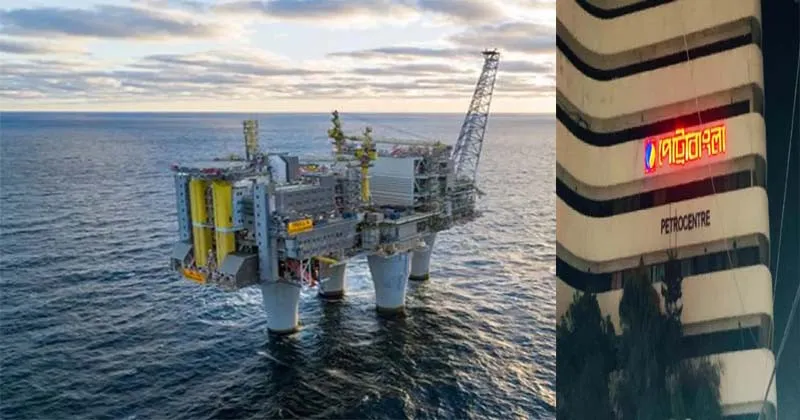
To inject new momentum into oil and gas exploration in the Bay of Bengal, the Bangladesh Oil, Gas and Mineral Resources Corporation (Petrobangla) is set to invite international tenders this coming Sunday. Foreign companies will be offered exploration opportunities across a total of 26 blocks, including 15 deep-sea and 11 shallow-sea blocks.
To boost the interest of foreign investors, several significant changes have been introduced to the ‘Bangladesh Offshore Model Production Sharing Contract (PSC) 2026’. The Cabinet Committee on Economic Affairs has already granted in-principle approval to the draft of the revised model.
Sources from the Energy Division and Petrobangla stated that all preparations for publishing the international tender are in their final stages. Notices will be published in leading domestic and international newspapers next week. Concurrently, roadshows and diplomatic campaigns will be conducted in various countries to attract foreign companies.
Mohammad Saiful Islam, Secretary of the Energy and Mineral Resources Division, stated that the revised PSC has been made more investor-friendly and commercially viable than its predecessor. Amendments have been introduced in various areas, including gas pricing, pipeline costs, data pricing, and the rate of profit allocation to the workers’ welfare fund.
He expressed optimism that the new framework would elicit a positive response from international energy companies.
According to Petrobangla sources, the sale of promotional packages will commence on June 1 following the publication of the tender notice. The deadline for tender submissions has been set for November 30. During this period, foreign firms will have the opportunity to acquire and analyze survey data conducted in the offshore areas.
It is understood that this international tender process is being launched swiftly as part of the 180-day special action plan initiated after the government took office.
Major Changes in the PSC
Under the revised contract, gas prices will be reassessed every five years, remaining within a predetermined ceiling and floor price.
Under previous regulations, companies were required to relinquish 50 percent of their territory during the exploration phase. This has been reduced to 20 percent in the new framework.
Additionally:
-
The profit allocation to the workers’ welfare fund has been slashed from 5 percent to 1.5 percent.
-
Pipeline tariffs will be determined based on negotiations with the bidders.
-
For deep-sea blocks, provisions have been made to peg the gas price up to 11 percent of the three-month average Brent crude price.
-
The floor price for Brent crude has been set at $70 per barrel, with a ceiling of $100 per barrel.
-
A decision has been made to use SOFR (Secured Overnight Financing Rate) instead of LIBOR for determining international interest rates.
According to relevant sources, these reforms were introduced based on recommendations from the international consultancy firm Wood Mackenzie.
No Response to the Previous Tender
A total of 26 blocks were demarcated in the Bay of Bengal following the resolution of maritime boundary disputes with India and Myanmar.
Previously, international tenders were invited in March 2024, but no foreign company submitted a final proposal despite multiple deadline extensions. Subsequently, based on the recommendations of an investigation committee, the new ‘PSC 2026′ was finalized after addressing objections regarding gas prices, infrastructure costs, and the workers’ welfare fund.
Positive Assessment by Experts
Energy experts view the government’s new initiative as both timely and realistic.
Badrul Imam, a prominent energy expert and geologist, noted that the gas crisis in the country is steadily worsening. Under these circumstances, conducting large-scale offshore exploration activities is critical.
In his view, if the investment climate for foreign corporations can be made attractive while safeguarding national interests and energy security, there is a strong possibility of achieving a positive outcome this time.


Discussion
No published comments yet. Be the first to join the discussion.