
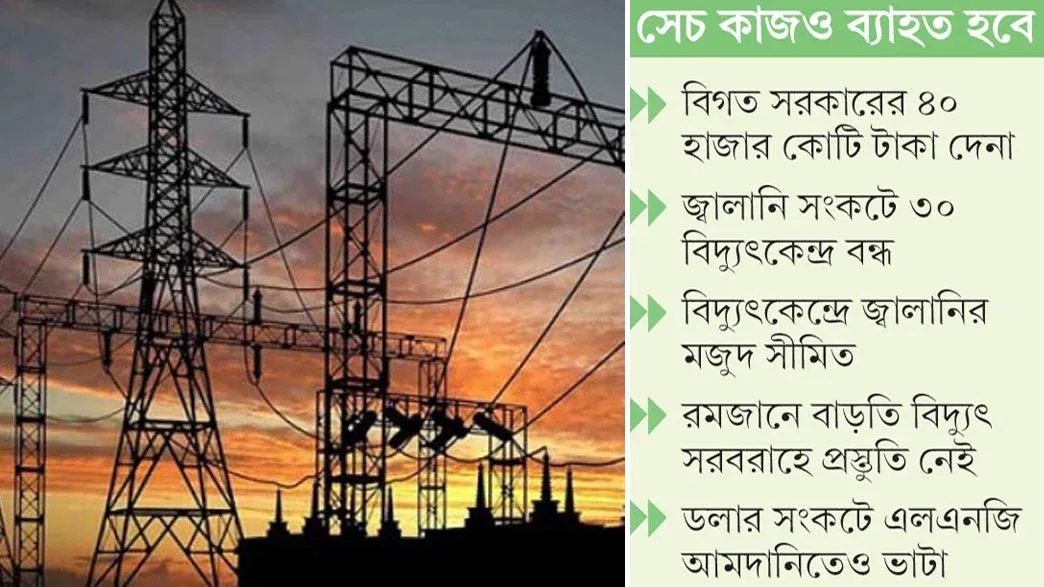
The country is likely to face a severe electricity shortage during the upcoming irrigation and summer seasons, officials warn. The holy month of Ramadan also begins in March; at that time, peak demand could reach 18,000 megawatts while maximum possible generation may be only about 14,000 megawatts. There is currently no arrangement to cover the roughly 4,000-megawatt shortfall.
Even before winter has fully ended, load-shedding has already begun in some urban and rural areas. Nationwide irrigation by farmers starts in mid-February, and summer begins in March. For these reasons, stakeholders in the power and fuel sectors fear the whole country will face an acute electricity crisis.
Extensive discussions about pre-emptive load-shedding are taking place across the Power Division, power producers, the Power Development Board (PDB), fuel and power experts, and consumer groups. They say ordinary people will suffer this time as they did last time. Sector insiders add that the interim government has effectively become helpless in dealing with the power sector’s situation.
Muhammad Fauzul Kabir Khan, adviser to the interim government on power, fuel and mineral resources, blames the severe power and fuel crisis on the “limitless plunder, corruption and mismanagement” of the fallen Hasina government. He said the government is taking multiple measures to overcome the crisis.
Officials in the Power Division say that although demand for gas has risen across power generation, industry and other sectors, extraction and supply have not increased. No new wells have been drilled in the country in the past 18 years. Moreover, the interim government is struggling with the liabilities of over Tk 40,000 crore left in the power sector by the previous Hasina administration. Because power producers have not received outstanding payments from the Power Development Board, they cannot open new LCs to import fuel. Officials say preparations have not yet been made to meet the additional electricity needs expected during Ramadan.
Experts say the previous Hasina government paid no heed to systems or regulations in the power and fuel sectors. The current government has also failed to prepare a roadmap, after consulting experts, to tackle the impending crisis. As a result, the debt burden is growing day by day. PDB is still incurring a loss of Tk 4 per unit of electricity.
Entrepreneurs say they cannot import initial fuel for power plants because outstanding electricity bills have not been paid. The amount of arrears owed to them by the government is increasing daily. With the gas shortage intensifying, higher-cost diesel-based plants will have to be run to manage the situation, which will further increase government expenditure and losses. If load-shedding occurs, marginal farmers will resort to diesel-powered irrigation pumps for field irrigation, raising their production costs.
Demand at 18,000 megawatts
Officials say that in March the country’s electricity demand will exceed 18,000 megawatts. To meet this demand, experts estimate supply would need to come from gas-based plants (6,400 MW), coal (5,558 MW), furnace-oil-based plants (4,149 MW) and other sources (2,125 MW) — a mix many specialists consider difficult to achieve. All furnace-oil-based plants are in the private sector; because of unpaid dues, these operators cannot import fuel, creating uncertainty about running furnace-oil plants in summer. Gas and coal shortages also make plans to increase generation uncertain.
Sources say the country currently has generation capacity of about 27,000 megawatts. Yet even at peak demand, actual generation has not exceeded 14–15,000 megawatts.
Arrears choking the power sector
PDB sources say the board’s arrears exceeded Tk 40,000 crore as of last November. Of this, about Tk 19,000 crore is outstanding for gas bills used at power plants. More than Tk 21,000 crore is owed to public and private power plants. Arrears in the private sector amount to roughly Tk 16,000 crore, including about Tk 10,000 crore owed to furnace-oil-based plants and around Tk 6,000 crore to other plants. If arrears are not cleared, these plants will not be able to import fuel and maintain generation. Petrobangla has already warned that it cannot continue gas supply to PDB if outstanding gas bills are not paid.
PDB has said Bangladesh owes Adani of India about Tk 8,400 crore. Adani has set a deadline of June to recover the debt. However, Bangladesh has strong objections regarding the coal bills of Adani’s power plant.
Private-sector operators say that although there is an obligation to pay power bills within 30 days, PDB has been unable to do so. As a result, necessary fuel oil imports for power plants are not possible. If bills are not paid soon, running power plants in summer will be impossible, meaning furnace-oil-based plants may not be able to supply electricity in the coming summer.
Domestic operators say most imported electricity comes from India’s Adani Power. The previous Hasina government did not impose any tax or VAT on Adani’s electricity. However, fuel imports face more than 15 percent tax and VAT. Even without Adani’s tax exemption, the per-unit cost comes to Tk 17.20; with tax and VAT on oil imports, the per-unit cost is Tk 17.06. Removing taxes on oil would reduce costs further. These factors are forcing the government to spend large sums.
Coal transport costs for thermal power are rising
A long-standing dispute exists between the Power Division and the Ministry of Shipping over channel maintenance charges for coal transport to the country’s thermal power plants via seaports.
Officials at thermal power plants say that when the plants were established, port authorities contracted to ensure navigability for coal transport, but that navigability has never been achieved as agreed. As a result, 40,000–50,000 metric-ton ships anchor offshore with coal, and smaller lighter age vessels carry coal to the plants, increasing costs. If channel maintenance fees are now imposed to keep the channel navigable, costs will rise significantly, increasing generation costs and forcing PDB to buy power at higher prices. To resolve the dispute, an advisory council meeting chaired by the economic adviser was held last Thursday, and a committee was formed to resolve the issue. The committee has been asked to submit a report within two weeks.
A government official told Amar Desh that decisions will be made based on that report. He said that uncertainty over coal transport will raise generation costs if coal-fired plants are operated.
The fuel division has said that in the current fiscal year Patuakhali power plant will have to pay an additional Tk 360 crore in channel maintenance fees for coal transport. For the Payra power plant, owned by Bangladesh China Power Company Limited, a channel maintenance fee of Tk 839.659221 crore has been demanded, and Tk 400 crore has been demanded for the Matarbari thermal power plant.
Gas shortage will affect power generation
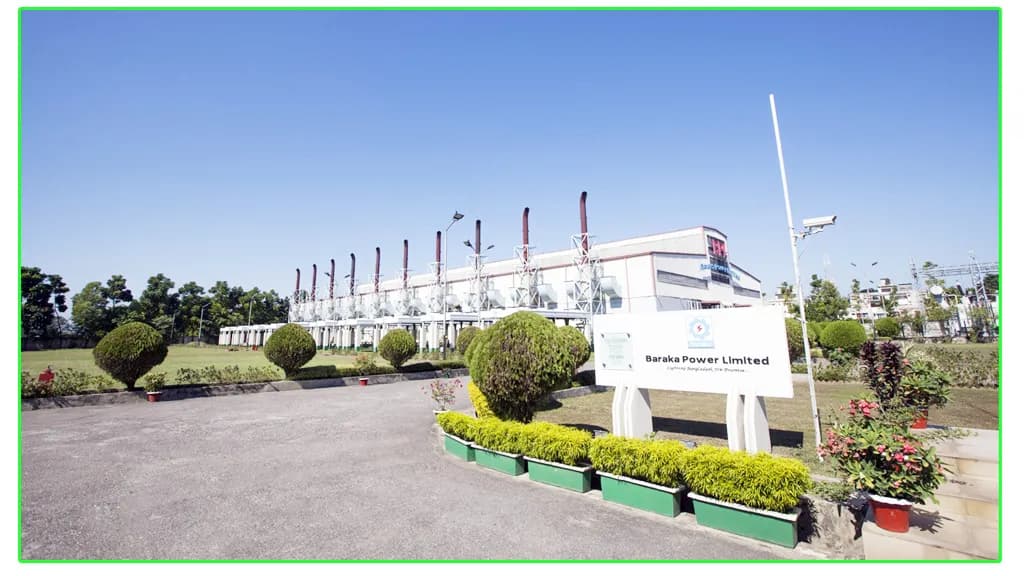
More than 30 public and private power plants of various sizes are currently shut down because they cannot be supplied with fuel. According to Petrobangla, daily gas demand in the power sector is 2,500 million cubic feet. For March, PDB has requested 1,600 million cubic feet of gas from Petrobangla for power generation.
But Petrobangla says it can supply at most 1,200 million cubic feet against that demand. In reality, several Petrobangla officials have told Amar Desh that supplying more than 1,000 million cubic feet to the power sector will not be possible.
Irrigation costs may rise
The irrigation season begins in March, when marginal farmers use electric irrigation pumps. If an electricity shortage occurs in the coming season, they will have to use diesel-powered pumps, increasing production costs. If production costs rise, agricultural commodity prices will also increase.
Yesterday, Saturday, electricity generation was 10,464 megawatts. Load-shedding at midday that day was 54 megawatts. Officials fear that as winter ends, demand and load-shedding will continue to rise.
Measures to tackle the crisis
Muhammad Fauzul Kabir Khan, adviser to the interim government on power, fuel and mineral resources, told Amar Desh that the government is under a huge debt burden. Although a sufficient number of power plants have been installed, fuel supply for them has not been secured. Power plants were set up without pipelines. The adviser said the previous Hasina government’s mismanagement and corruption have crossed all limits. Banks also lack sufficient funds. “We will import fuel now, but we do not have the necessary dollars,” he said.
Describing government steps to address the crisis, the adviser said measures have been taken to import and supply fuel quickly so that people do not suffer during Ramadan and to ensure uninterrupted power supply during the irrigation and summer seasons. Discussions are also underway on clearing arrears owed to power producers. “We hope we can overcome the crisis,” he said.
PDB Chairman Rezaul Karim said priority will be given to the coming summer and irrigation seasons. He told Amar Desh that planning must take into account the current precarious state of the banks. He said the government is providing sincere cooperation and expressed hope that with continued cooperation from all parties the crisis can be overcome.
Experts stress fuel supply
Energy expert Professor Dr M. Tamim told Amar Desh, that although the country has adequate generation capacity, the main problem is fuel supply. As arrears owed to power producers grow, they cannot import fuel to keep plants running. He said the faster the government acts to import fuel, the sooner the emergency situation can be managed.
K. M. Rezaul Hasnat, president of the Bangladesh Independent Power Producers Association (BIPPA), told Amar Desh that the interim government is paying the price for the previous government’s rampant irregularities and financial plunder. He said all parties must come together to tackle the looming power crisis and that long-term solutions must be found.
Discussion
No published comments yet. Be the first to join the discussion.