
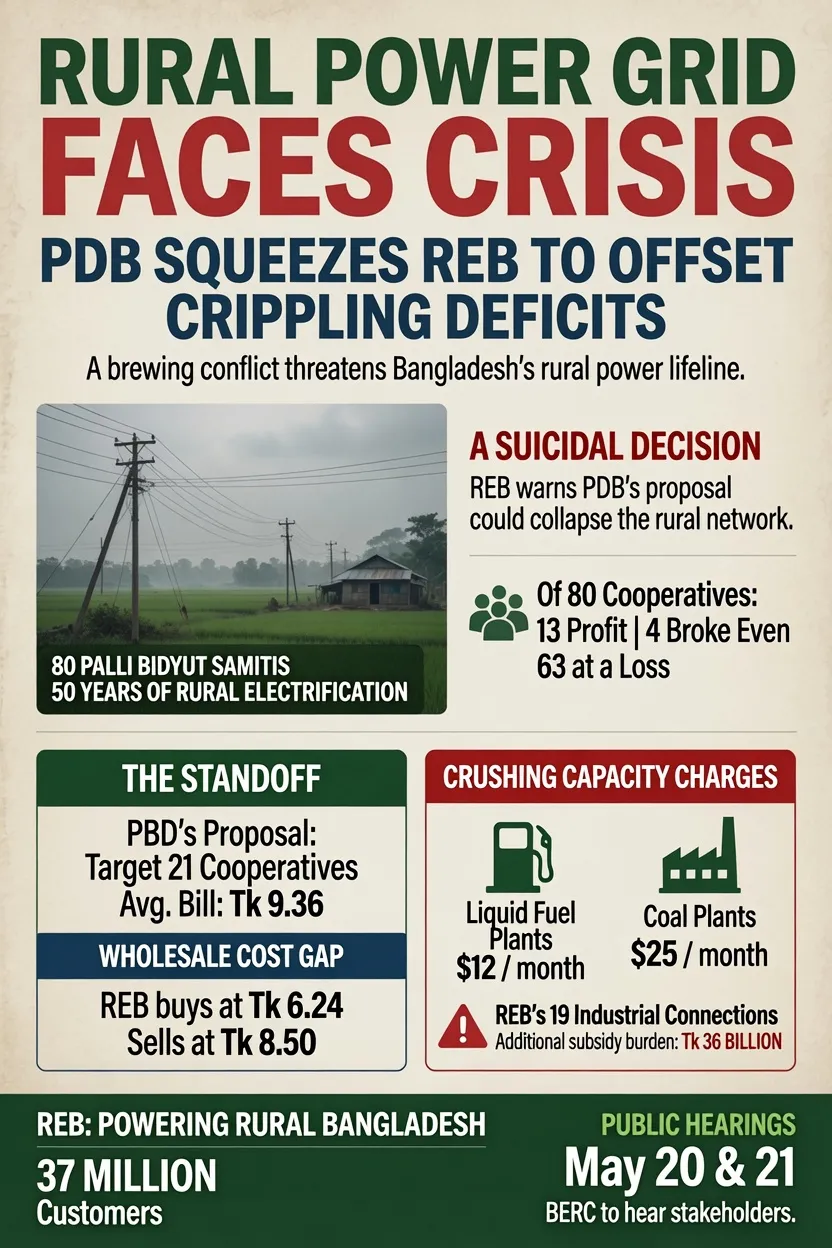
A brewing financial conflict between two state-run energy giants is threatening the stability of Bangladesh’s rural power infrastructure. The Bangladesh Power Development Board (PDB), suffocating under mounting financial deficits, is actively pressuring the Bangladesh Rural Electrification Board (REB) to absorb higher wholesale electricity costs—a move REB officials warn could collapse the entire rural distribution network.
For five decades, the REB has successfully electrified rural Bangladesh through a network of 80 cooperative societies (Palli Bidyut Samitis). The survival of this vast network hinges on a delicate internal balance: a handful of highly profitable cooperatives subsidize the massive losses of the rest.
Now, PDB wants a cut of those profits. In a controversial new proposal submitted to the Bangladesh Energy Regulatory Commission (BERC), PDB has requested a targeted hike in wholesale electricity rates specifically for REB’s profitable cooperatives.
REB officials have sounded the alarm, calling the proposal a “suicidal decision” for the government. They point out a stark reality: last fiscal year, only 13 of the 80 cooperatives turned a profit, and four broke even. The remaining 63 operate at a loss and are kept afloat solely by the surplus generated by the profitable few. If PDB drains that surplus, the rural power supply chain could completely unravel.
BERC Chairman Jalal Ahmed confirmed that the commission will hold public hearings on May 20 and 21 to gather stakeholder feedback before making a final, consumer-conscious decision.
The Math Behind the Standoff
PDB argues that the current pricing structure is fundamentally unfair and bleeds its own coffers. Because REB receives electricity at a discounted rate compared to urban distributors, any increase in REB’s consumption drags down PDB’s average wholesale revenue. Currently, the average wholesale cost of electricity is Tk 7.04 per unit, but PDB receives only Tk 6.99.
According to PDB’s calculations, REB buys power at Tk 6.24 per unit and sells it at an average retail price of Tk 8.50—a margin unmatched by any other distribution company. For comparison, Dhaka’s DESCO buys at Tk 8.58 and sells at Tk 10.40.
To bridge this gap, PDB’s proposal targets 21 specific REB cooperatives whose customer demographics mirror urban distributors like DESCO and DPDC. In these 21 cooperatives, the average per-unit bill is Tk 9.36, compared to just Tk 7.85 in the remaining 59. PDB argues that treating these 21 cooperatives like urban distributors and charging them a higher wholesale rate will significantly boost its revenue.
PDB officials note that supplying cheap power to REB accounted for 63 % of the board’s financial deficit in the 2024–25 fiscal year, a burden they expect to worsen next year.
The Crushing Weight of Capacity Charges
Further exacerbating PDB’s desperation are the astronomical capacity charges it owes to power generation companies. PDB pays up to $12 (Tk 1,476) monthly for liquid fuel and gas-based plants, and a staggering $25 (Tk 3,070) for coal-based plants.
The pressure is mounting. REB currently has 19 massive industrial connections (totaling 2,000 MW) in the pipeline. PDB warns that once these go live, it will face an additional subsidy burden of Tk 36 billion. PDB argues that if these large industrial clients in economic zones were supplied via 132kV lines instead of 33kV lines, the per-unit subsidy burden could drop by Tk 2.24.
A Threat to the Cross-Subsidy Lifeline
Caught in the crossfire, REB submitted its own appeal to BERC on May 6, seeking a 5.93 % hike in retail electricity prices. The rural board reported a deficit of Tk 1,698 crore for the 2024–25 fiscal year, projecting it could swell to Tk 2,368 crore this year.
REB is a behemoth, serving roughly 37 million customers—77% of the nation’s total electricity users—and managing 57% of the national distribution network. Crucially, 56% of its power goes to residential users, primarily low-income households reliant on subsidized “lifeline” tariffs. Because REB hasn’t proposed hiking tariffs for these vulnerable consumers, an increase in wholesale costs would cripple the agency financially.
Energy experts emphasize that the entire power sector relies on a consumer-driven cross-subsidy system. High-volume users pay premium rates (up to Tk 14.61 per unit for residential usage over 600 units) to offset the costs for low-volume, low-income users.
Within REB, this cross-subsidy is geographical. Last fiscal year, the Tk 3,515 crore revenue generated by the 13 profitable cooperatives—mostly located in the heavily industrialized belts of Dhaka, Gazipur, and Narayanganj—was used directly to plug the deficits of 65 loss-making cooperatives.
Shamsul Alam, Energy Advisor for the Consumers Association of Bangladesh (CAB), criticized PDB’s maneuver. He stated that because REB operates strictly on this cross-subsidy model to keep rural areas electrified, isolating 21 cooperatives for higher tariffs is illogical. He accused PDB of attempting to offload its own “exploitative expenditure burden” onto the shoulders of the rural distribution network.
Discussion
No published comments yet. Be the first to join the discussion.